



Join us to learn more about the opioid and stimulant crisis in Kansas. Engaging together in this proactive effort to build a collaborative response will help to prevent the escalation of this crisis in Kansas.
2026 Conference Rates:
- Early Bird: Through August 31
- $70
- General Conference: September 1 – October 30
- $100
- On-Site Registration: After October 30
- $125
- Early Bird: Through August 31
DCCCA Cancellation Policy:
Conference registrations may be transferred to another individual at any time. However, refunds will not be made after Friday, October 16, 2026.
For questions regarding your registration, please contact DCCCA Communications.
Keynote Speakers
Officer Jermaine Galloway
Tall Cop Says Stop
Officer Galloway, a Texan, known nationally as the Tall Cop, has worked in substance abuse prevention and education for over 20 years. After playing Division I basketball and receiving his BA in Sociology from the University of San Francisco, he worked as a law enforcement officer for 18 years. His various assignments included: alcohol compliance and enforcement, CSI, DUI task force, officer mentoring, and a field training officer.
In 2007, Jermaine started the company known as “Tall Cop Says Stop™”. The Tall Cop has conducted trainings in every U.S. state and Canada, and currently devotes thousands of hours each year to training professionals and communities on drug and alcohol prevention, education, and enforcement. The Tall Cop is unique in that he spends hundreds of hours with “boots on the ground” highlighting drug culture in various communities. To date, the Tall Cop has trained more than 800,000 professional and community members. He has trained across the U.S. and in other countries such as Canada and the Bermuda Islands. The Tall Cop has conducted more than 8,400 community scans, identifying the drug culture and climate. His program, “High in Plain Sight”, is a nationally recognized program, that provides training, education, and enforcement strategies for community substance abuse issues.
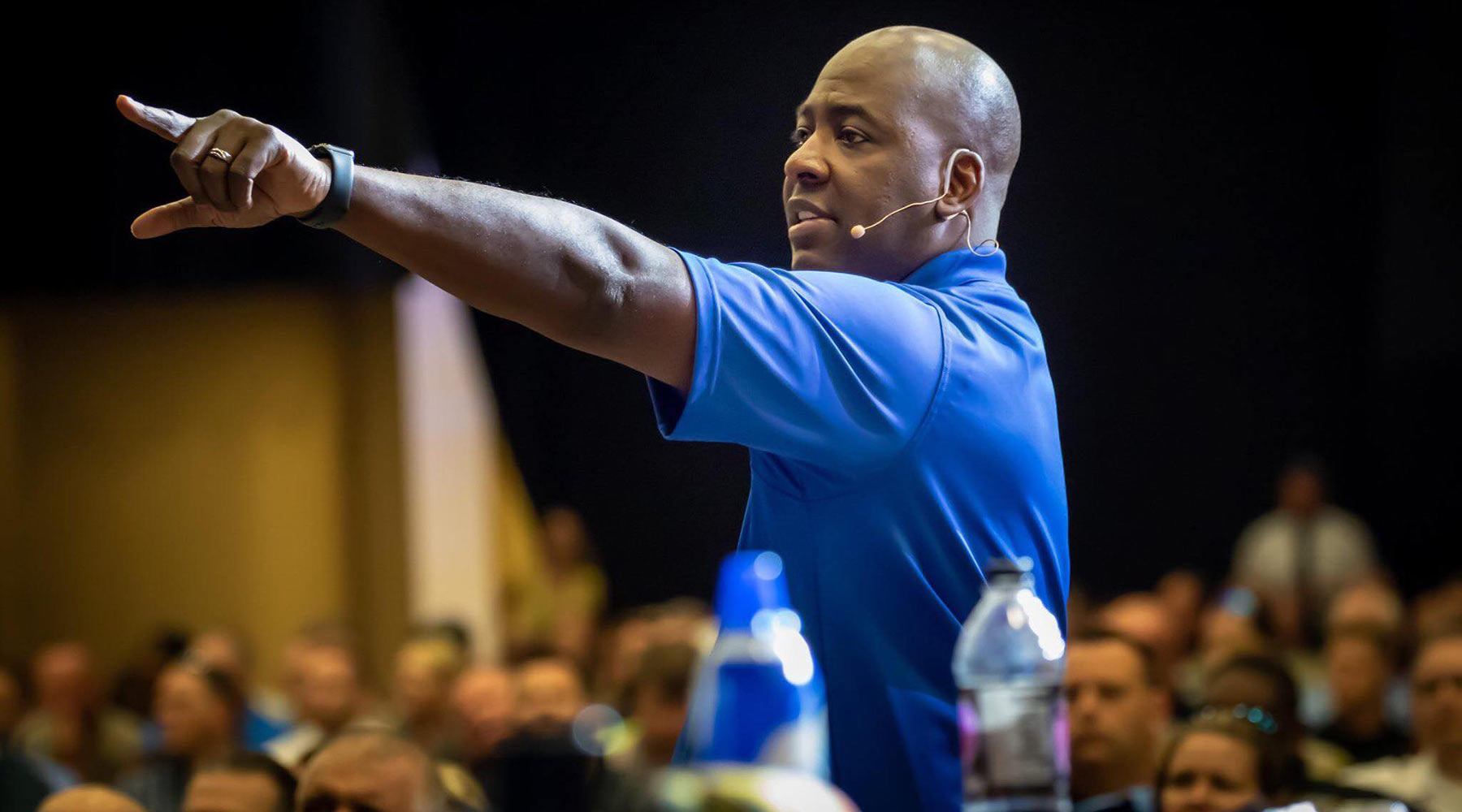

Additionally, Jermaine Galloway has published articles, been referenced in books, and has been highlighted in many media interviews. The Tall Cop’s fast-paced and high-energy class provides attendees with an unparalleled learning experience! At the end of 2023, Galloway Started a podcast to provide education to everyone. The Tall Cop Says Stop Podcast can be found on both Spotify and Apple platforms. Most recently, at the beginning of 2024, Jermaine has been certified as an International Instructor by the International Association of Directors of Law Enforcement Standards and Training.
Tom Farley
Tom Farley grew up in Madison, WI, and graduated from Georgetown University with a degree in Marketing. He began his career in banking and finance before running The Chris Farley Foundation (1999–2012), a nationally recognized nonprofit focused on substance abuse prevention. Through humor-based programs, he helped young people build communication skills and create supportive environments.
In 2008, Tom co-authored The Chris Farley Show, a New York Times bestseller about his late brother, comedian Chris Farley. He has appeared on The Today Show, Good Morning America, and Larry King Live to discuss addiction and recovery.
Now in recovery himself, Tom is a passionate advocate for mental health and addiction treatment. He works at Recovery.com as Community Outreach Director, connecting people with the resources they need to heal. As a speaker, he shares his journey to break stigma, inspire hope, and foster connection. Tom lives in Madison, WI.

Conference Schedule
Session Tracks
Learn about what’s new regarding opioids and stimulants.
| Cutting Edge: Adulterants and Emerging Substances | Seth Chauhan – KU Addiction Medicine Fellowship | This presentation will discuss trending adulterants in the illicit drug supply including xylazine, medetomidine, BTNPS, synthetic opioids such as orphine and nitazine, and benzodiazepines as well as implications for medical management and withdrawal symptoms. Will also include more classical adulterants if time permits. |
| Beyond the Spreadsheet: Measuring Real Impact from Opioid Settlement Investments | Margo Pipkorn, Vanessa Mallory – The Steadman Group, LLC | Moving beyond program monitoring, this session explores how communities can measure the true impact of opioid settlement investments. Participants will learn practical approaches for linking settlement-funded programs to population-level outcomes, assessing evaluation readiness, and using findings to guide decision-making, stakeholder engagement, and future funding priorities. |
| High on Innovation: Effects of Emerging Opioids and other Psychoactives | Ashley Haynes – Robert J Dole VA; University of Kansas- School of Medicine Wichita | In the wake of the state-wide kratom ban, new agents are set to emerge. We will discuss some new kratom analogs, the novel opioid orphine and related compounds, and the emergence of shop-sold mushroom-containing chocolate bars. |
| AI, Ethics, and Person-Centered Behavioral Health Care: Balancing Innovation, Technology, and the Human Connection | Pete Nielsen – National Behavioral Health Association of Providers (NBHAP) | Artificial intelligence is rapidly changing behavioral health care, from AI-driven education and clinical decision support to chatbots, documentation tools, digital engagement, and individualized treatment planning. But as these technologies become more sophisticated, behavioral health professionals must ask an important question: How do we use AI to strengthen person-centered care without allowing technology to replace the human relationships at the heart of treatment and recovery? This presentation explores the ethical, practical, and emerging uses of artificial intelligence and other technologies in substance use disorder and behavioral health treatment. Participants will examine how AI can support individualized education, improve access to information, enhance client engagement, assist clinicians, and create more responsive treatment experiences while also considering critical concerns involving privacy, confidentiality, informed consent, bias, accuracy, professional boundaries, clinical judgment, and overreliance on automated systems. The session will examine the evolving role of AI-powered chatbots and educational tools in supporting person-centered care and discuss where technology can appropriately supplement—but should not replace—the therapeutic alliance, professional expertise, peer support, and authentic human connection. Through practical examples and ethical considerations, participants will learn how behavioral health organizations and professionals can responsibly incorporate AI into services while maintaining accountability, protecting clients, and ensuring that technology remains a tool in service of the individual rather than becoming the driver of care. Ultimately, the future of behavioral health may not be a choice between technology and human connection. The challenge will be determining how to use both responsibly to create care that is more accessible, personalized, ethical, and genuinely person-centered. |
| Fatal Drug Overdose in Kansas: Data Review | Scott Johnston, | An overview of fatal drug overdose surveillance in Kansas will be presented, including data collection, emerging trends, and demographics. The results of the Kansas Fatal Drug Overdose Vulnerability Assessment will also be presented, which was developed to rank counties by their combined burden of social vulnerability indicators associated with overdose. |
Explore resources to improve knowledge and advance health outcomes for patients.
| Medical Approaches for Treatment of Stimulant Use Disorder | Ashley Haynes – Robert J Dole VA; University of Kansas- School of Medicine Wichita | We will discuss medication approaches to treatments for stimulant use disorder, including ASAM recommendations and new literature and emerging studies. |
| Establishing an Addiction Coordinator Consult Service: A Care Transition Model for Hospitalized Patients with Opioid Use Disorder | Roopa Sethi, Carlie Seifert, Ann Brandt – The University of Kansas Health System | This presentation highlights a quality improvement initiative focused on integrating an inpatient addiction coordinator model into established hospital workflows to enhance care for patients with substance use disorders. The program leveraged outpatient licensed addiction counselors as dedicated care navigators, utilizing electronic health record (EHR)-enabled consults, bedside patient engagement, and warm handoffs to community-based treatment providers. Early results demonstrate improved care coordination, standardized referral processes, strong clinician adoption and support, achievement of patient contact rates exceeding 75%, and measurable increases in both opioid treatment program enrollment and successful referral completion. These findings suggest that embedding addiction-focused care navigation within inpatient settings can strengthen continuity of care and improve access to evidence-based treatment services. |
| “We Don’t Do That Here” to Standard Practice: What It Really Takes to Integrate MOUD into Primary Care | Shawna Wright – KU Center for Telemedicine & Telehealth / Project ECHO, LaDonna Hale – Wichita State University, Department of Physician Associate | Primary care is essential to expanding access to medications for opioid use disorder (MOUD), yet implementation remains challenging. This interactive panel brings together Kansas leaders who successfully integrated MOUD into clinical practice and education to discuss practical strategies, persistent barriers, and lessons learned that can help make MOUD a sustainable primary care service line. |
| Prescriber Experiences with Substance Use Disorder Care: Barriers and Facilitators to Screening, Intervention, and Treatment | Amanda Aguila Gonzalez, Elizabeth Ablah – University of Kansas School of Medicine-Wichita, Kaylee Hervey – Sedgwick County Health Department | This study was designed to understand the facilitators and barriers experienced by prescribers when screening, intervening, referring, or treating patients with a substance use disorder (SUD). Specifically, the study explored the attitudes, policies, and practices associated with screening, briefly intervening, referring, and treatment patients with medication for opioid use disorder. |
| From Findings to Action: Strengthening Systems of Care for Perinatal Substance Use Disorder | Patricia Carrillo, Brian Harris, Margaret Lloyd-Sieger, Madison Roberts – University of Kansas Center for Public Partnerships and Research | Kansas has made important progress in addressing perinatal substance use disorder, including expanded access to medication for opioid use disorder and more family-centered child welfare policies. Drawing on findings from a 2025 report, this panel explores statewide trends, promising practices, and systems-level strategies to strengthen coordination, provider capacity, and outcomes for families. |
Learn about best practices for opioid and stimulant prevention.
| Detect, Respond, Evaluate: A Community Approach to Overdose Prevention | Kaylee Hervey – Sedgwick County Health Department, Chuck Ulrich – Wichita Police Department, Amanda Aguila Gonzalez – University of Kansas School of Medicine-Wichita | How can communities reduce overdose deaths through collaboration? This session explores how drug intelligence, overdose prevention strategies, and program evaluation work together to identify emerging threats, guide timely interventions, and measure impact, highlighting the critical partnership between public safety, public health, and community organizations. |
| Drug Endangered Children: Identification and Best Practices for Families Affected by Substance Use | Jennifer Gassmann – Kansas Children’s Service League, Shelly Schneider – Kansas Department for Health and Environment | This training examines the impact of caregiver substance use on children and risk factors that can endanger a child’s physical and emotional well-being. It highlights strategies for supporting families affected by substance use, and also emphasizes community collaboration in providing help and support to children and families. Participants will leave with an awareness of their opportunity to help break cycles of substance use and adversity. |
| Fentanyl and the personal impact: Turning pain into purpose | Amber Saale-Burger, Max Burger – TK fights Fentanyl Inc., Kaylee’s Dad is Mad | Following the loss of their daughter to illicit fentanyl poisoning, Amber Saale-Burger and Max Burger transformed grief into action. This presentation explores the impact of fentanyl on families, effective community-based prevention strategies, harm reduction efforts, policy advocacy, and lessons learned through grassroots overdose prevention work in Kansas. |
| Reclaiming What’s Possible: Bringing HOPE to Community Prevention | Dana Book – FiLo Strategies | Prevention messages often lead with crisis, risk, and harm. This interactive workshop brings together Healthy Outcomes from Positive Experiences (HOPE) and Positive Community Norms. Participants will explore how perceptions and positive experiences influence behavior, identify existing community strengths, and develop messages that support connection, resilience, and opioid and stimulant prevention. |
| The Community Think Tank: where prevention leaders solve problems together | Jeremiah Olguin, Mariela Celin Ruiz – F!GHT FENTANYL | This interactive think tank transforms attendees into collaborative problem-solvers. Participants identify pressing prevention challenges, exchange successful strategies, and develop practical solutions through facilitated discussion, audience mapping, and brainstorming. Attendees leave with new partnerships, actionable ideas, and resources they can adapt to strengthen prevention efforts in their own communities. |
Discover relevant strategies to build successful partnerships and pathways to treatment and recovery.
| Peer Support for Substance Use Recovery in County Jail: Transforming Lives and Jail Culture | Nick Casarona, Adam Cobuluis – Mirror, Inc. Keegan Heiland, Joe Lonnberg – Shawnee County Department of Corrections | This presentation explores how embedding peer support within a county jail transforms recovery, reentry, and correctional culture. Through the Shawnee County Honor Module partnership, attendees will examine how lived experience, collaboration, and pre release engagement improve connections to treatment, strengthen hope, and support long term recovery outcomes. |
| Kratom and the Battle of the Deltas in Kansas | Technical Trooper Leanna Setzkorn, Technical Trooper Nathan Makings – Kansas Highway Patrol | This session will highlight what kratom is, the new law, and short and long term effects. It will cover Delta 8, 9, and 10 THC, what it is and what the confusion is with legality. We also will highlight products we are seeing for sale in Kansas. |
| Peer Mentors Teach Inmates to Break Chains of Addiction Using SMART Recovery | Tisha Beckman, Ryan White, Sherry White – High Point Advocacy and Resource Center, Inc | You’ll learn how we created a program from the ground up inside our local jails, utilizing SMART Recovery Learn SMART InsideOut FAST, a science-based curriculum, and how we achieved an astounding success with 80% of participants still remaining substance-free and living in long-term recovery, 1-year post-graduation from our program. |
| Opioid Awareness for First Responders | Josh Magaha – Kansas City (KS) Fire Department | Firefighter Josh Magaha (KCKFD, 25-year first responder) shares frontline fentanyl response experience and exposure-risk realities, drawing on 15,000+ student presentations and his role advancing Kansas’s school naloxone law. |
| How Corrections Professionals Can Support People Through Addiction | Tia Murphey – Kansas Department of Corrections | Corrections professionals can strengthen recovery outcomes by using a coaching mindset, Cognitive Behavioral Therapy principles, motivational engagement, trauma informed practices, and harm reduction tools. Learn how to start building a strong professional alliance to help people stay alive, supported, and ready for change. |
Explore treatment and recovery options and best practices through a trauma informed lens.
| What shapes recovery? Looking beyond the individual to create lasting change | Seth Dewey – Mirror, Inc. | Recovery is influenced by far more than individual motivation or treatment alone. This session explores how relationships, organizations, communities, and systems shape recovery outcomes. Participants will gain practical strategies for recognizing barriers, strengthening recovery supportive environments, and applying systems thinking to improve outcomes across behavioral health settings. |
| ASAM 4th Edition Criteria Vol. 1 & 2 | Emily Swanzy – Carelon Behavioral Health | This presentation will provide an overview of the ASAM 4th Edition Criteria Volume 1 & 2 and how it differs from ASAM 3rd Edition. It will also describe how the criteria is used in the determination of appropriate substance use disorder treatment placement, treatment planning and movement through the continuum of care. |
| We know what works. Why aren’t we doing it? Using implementation science to move evidence into practice | Sherrie Watkins – Opioid Response Network | Communities across Kansas are working to address opioid and stimulant use disorders using evidence-based practices, yet many proven interventions remain underutilized or inconsistently implemented. This gap often leaves providers, leaders, and community stakeholders frustrated as they encounter barriers that prevent effective solutions from reaching the people who need them most.This session introduces implementation science as a practical framework for moving from knowledge to action. Participants will explore why evidence-based practices succeed in some settings and fail in others, common implementation barriers in rural and urban communities, and practical strategies for improving adoption, fidelity, sustainability, and system change |
| The Person Behind the Peer: Lived Experience and the Power of Peer Support | Tracey Striplin, Carrie Stillian – DCCCA, Keatherann Sharp – Wyandotte County Government | The panel shares their recoevery stories alongside a clear look at what peer support is and why it belongs at the center of substance use disorder care. This session breaks down the peer support role and shows how lived experience builds trust that clinical training cannot. |
| Recovery Starts with Access: Reducing Childcare Barriers Through Family-Centered Substance Use Treatment | Zenova Williams, Stacy Conner – Washburn University, Department of Family & Human Services | Parents seeking outpatient SUD treatment often face barriers such as inadequate childcare, transportation, and scheduling. This presentation shares Kansas research on treatment centers’ childcare capacity, implementation challenges, and family-centered solutions. Participants will explore practical strategies to reduce barriers, strengthen agency capacity, and improve treatment engagement and recovery outcomes for families |
| Recovery Housing Enhancements for Transition Age Youth (18-24) | Paul Hunt – Kansas Department of Housing and Disability Services, Gina Ross, Erica Sigg, Ashley Dryden – Friends of Recovery | The State of Kansas was awarded a one time only supplemental grant to enhance recovery programs for people aged 18 to 24 (transition age youth). Friends of Recovery was selected to develop sustainable recovery enhancements for this population statewide and will present on that experience. |
| Human First: Recognizing Biases and Reclaiming the Recovery Narrative in MAT | Melissa Lubbers-Billiot – Community-Bridge Recovery, Inc. | During this presentation attendees will Identify personal, cultural, and systemic biases that influence perceptions of individuals with substance use disorders, particularly those who engage in medication assisted treatment as part of their recovery. Participants will explore how implicit and explicit biases shape the way society views addiction, including assumptions about morality, willpower, responsibility, and “deservingness.” By recognizing these biases, attendees will better understand how stigma contributes to shame, reduced help‑seeking, and inequitable access to treatment for people with substance use disorders. Participants will examine how language and communication patterns impact treatment engagement, recovery outcomes, and community attitudes toward substance use disorders. |
| Making the case for Tobacco Treatment as Part of Recovery-Oriented Care | Alberto Reyes Rodriguez – Kansas Department of Health and Environment, Christine Young – Wichita State University Community Engagement Institute | Despite declining tobacco use in the general population, tobacco use remains disproportionately high among individuals with behavioral health conditions. This presentation will explore the factors contributing to these disparities, examine the impact of tobacco use on recovery, and discuss recovery-oriented strategies to integrate tobacco treatment into behavioral health settings and denormalize tobacco use. |
Register Here
DCCCA Cancellation Policy: Conference registrations may be transferred to another individual at any time. However, refunds will not be made after Friday, October 16, 2026.
For questions regarding your registration, please contact DCCCA Communications. Thank you!